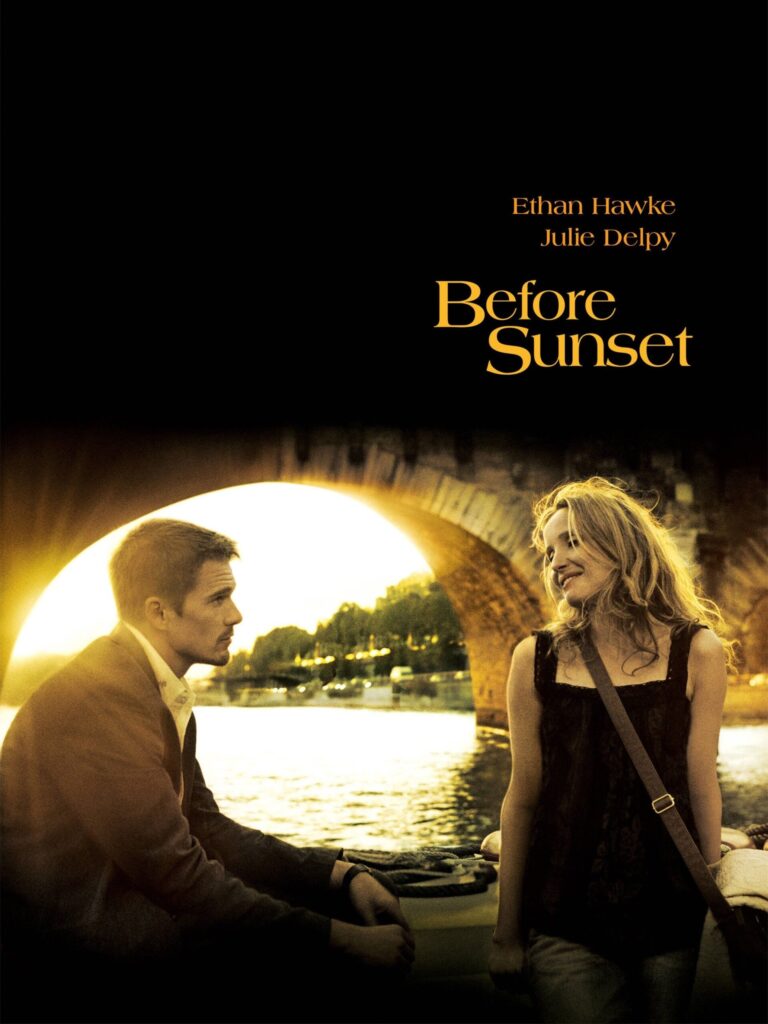
When Before Sunrise was released in January 1995, it was a critical and commercial success. However, this wasn’t a film that screamed “franchise.” Despite this, a sequel finally hit theaters in 2004. The film follows Jesse and Celine as they reunite in Paris nine years after their first meeting. Jesse is an author on the final leg of his European book tour when he runs into Celine. Although he only has a little over an hour before he needs to be at the airport, the duo reconnects as they walk through Paris. As I discuss Before Sunset, I want to issue a formal spoiler alert.
The origins of the film date back to the late 1990s. Linklater, Krizan, Delpy, and Hawke began imagining a larger budget sequel, but they were unable to secure funding. Over time, each of them started writing down ideas for a sequel. In 2003, the writers came together to pitch their ideas and work on the screenplay. They incorporated elements from their real lives into the screenplay, most notably, Ethan Hawke’s highly publicized divorce from Uma Thurman. Despite the goal of having a larger budget, the screenplay the four wrote was for a scaled-back version. In fact, the film was shot mainly in order, as they wrote and improvised as the shoot went along. Ultimately, the four of them received a shared “screenplay by” credit, while Linklater and Krizan shared a “story by” credit. The film was shot in the intense summertime heat, one of the hottest on record for Paris. Additionally, the film features about 11 minutes of Steadicam shots, allowing for easy capture of walking-and-talking scenes.
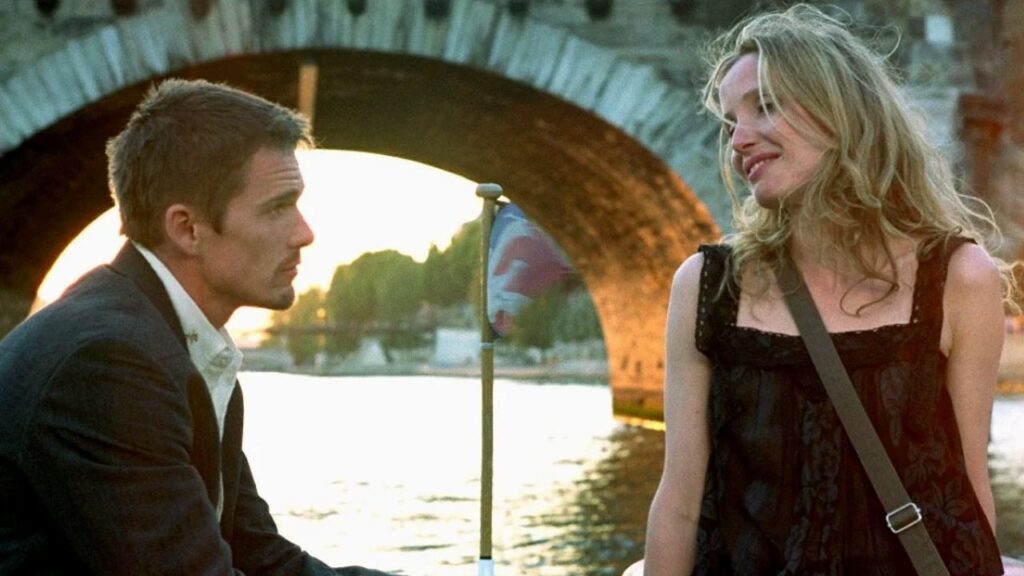
One of my favorite elements in film is change. Time forces characters to evolve and grow. That is true in single, epic films like Giant or multi-year franchises like Harry Potter. I also find this to be true in life. As humans, our primary function is to grow and evolve. I’m not the same person I was five minutes ago, and I am certainly not the same person I was five years ago. After nine years apart, our characters are no different when it comes to change. Jesse is an author famous for writing a book inspired by his rendezvous with Celine. However, he is married with a kid. Celine still lives in Paris and works for an environmental company. She has had several relationships, but none have led to marriage. She later complains to Jesse that men go out with her, break up, get married to someone else, and thank her. Just as the characters have matured, so have the camera movements. The camera in the first film was simplistic; now I notice overarching crane shots. They still help to tell the story, but would feel out of place in the first film. Not only have these characters matured emotionally, but they have also matured physically. Celine looks like she hasn’t aged much. The only significant difference is that she wears her hair up. Jesse, on the other hand, is still skinny, has shorter hair, and his goatee is a bit fuller. The line, “Life feels more immediate,” is particularly resonant as one ages.
Memory is a significant theme in the film, and it goes hand in hand with regret. Jesse immortalizes that night through his book, “This Moment.” The book is a way for Jesse to hold onto those memories. When he eventually reunites with Celine, her memories are hazy (or so we think). She doesn’t think they slept together, but Jesse insists they did. Celine admits to being blown away by how well Jesse remembers that night. I don’t know which character said it, but it stuck with me, so I wrote it down. Someone utters the line: “Memory is a wonderful thing if you don’t have to deal with the past. A memory is never finished as long as you are alive.” It is, at one time, sad, poignant, and faithful. However, memory can also be what we make of it. During an argument, it comes out that Celine did, in fact, remember sleeping together. She just wanted to forget it so she wouldn’t have to think about what things could have been. That’s what she tells Jesse, but in reality, she is pissed. Not only is she upset that Jesse wrote a book about her, but she’s just as upset because the book stirred shit up in her (as she says). It reminded her that she was once romantic and optimistic, but now, things have changed. She feels much more cynical than she was nine years earlier. This is a perfect segue into the theme of regret. Both have so much sadness.
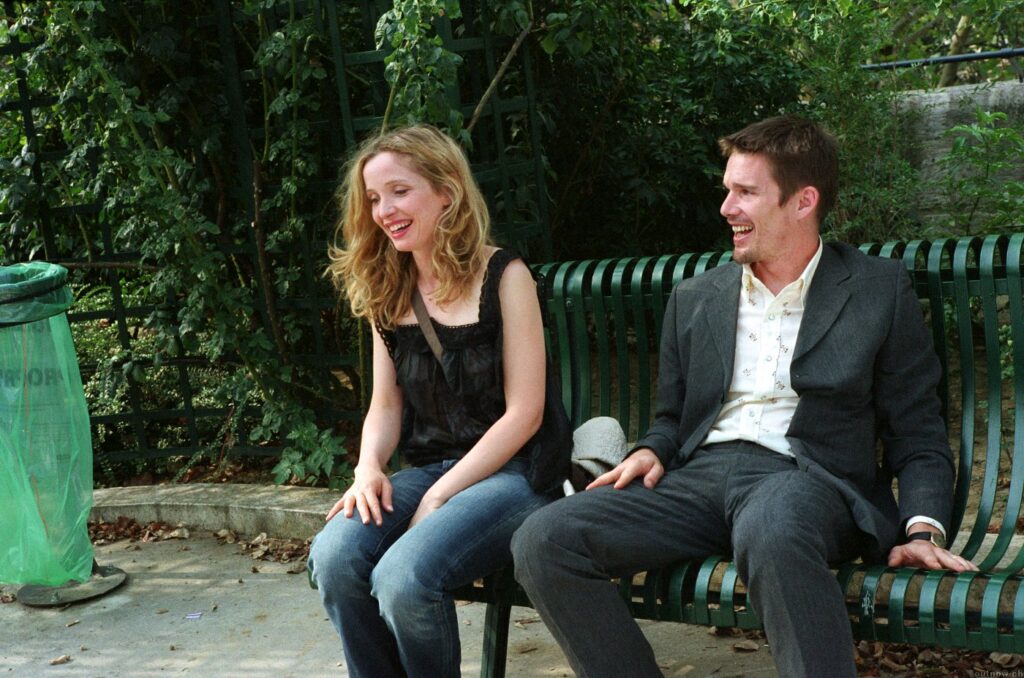
The obsession with regret makes sense. After all, the studio marketed the film with the tagline, “What if you had a second chance with the one that got away?” It becomes clear that both Jesse and Celine regret not exchanging their contact information. They wonder what could have been. Although her grandmother had died and she was at the funeral, Celine regrets her inability to meet Jesse at the Vienna train station, especially after learning he was there. She regrets that she wasted a lot of time with people who never wanted to marry her, instead of staying in contact with the one guy who did, Jesse. She tells Jesse that they probably would have gotten on each other’s nerves if they had gotten together all those years ago, but I don’t buy it. It’s another way to try to prevent heartache. She also regrets not trying to find Jesse when she moved to New York in 1996 to attend NYU. Despite living in NYC for three years, she never attempted to see him. When she reads Jesse’s book, she has the aforementioned reminders of her youthful optimism and romanticism, but it also leaves her numb, bitter, and dead inside.
Jesse also regrets not pursuing Celine. In an ironic twist of fate, he ends up marrying a woman because she is pregnant, just like his parents died. And just like his parents, he stays married for the sake of his son, Hank, whom he adores, despite not being in love with his wife. He tells Celine that he loves his son and will do anything for him. In fact, those moments with his son are the only time he feels happy. He tells her that he has dreams where they’re back in Vienna and he pursues her, but then he wakes up to reality and begins to sob. He sobs not only because he is not with Celine, but also because he feels guilty romanticizing about this other woman and waking up next to his wife. Unless he decides to pursue Celine, it appears he has completely given up on true love.
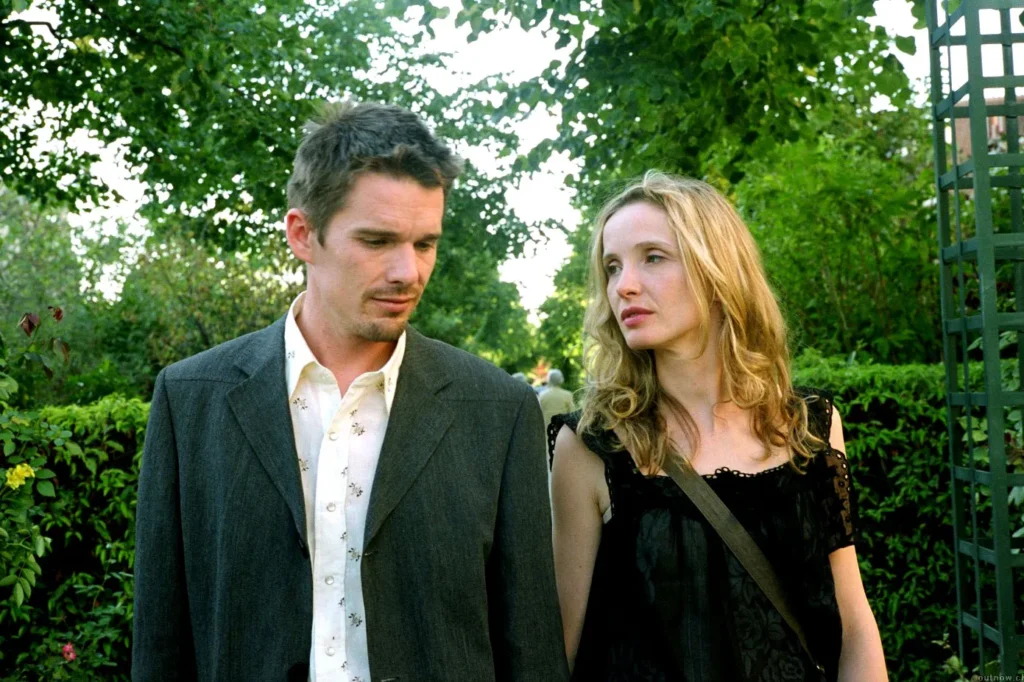
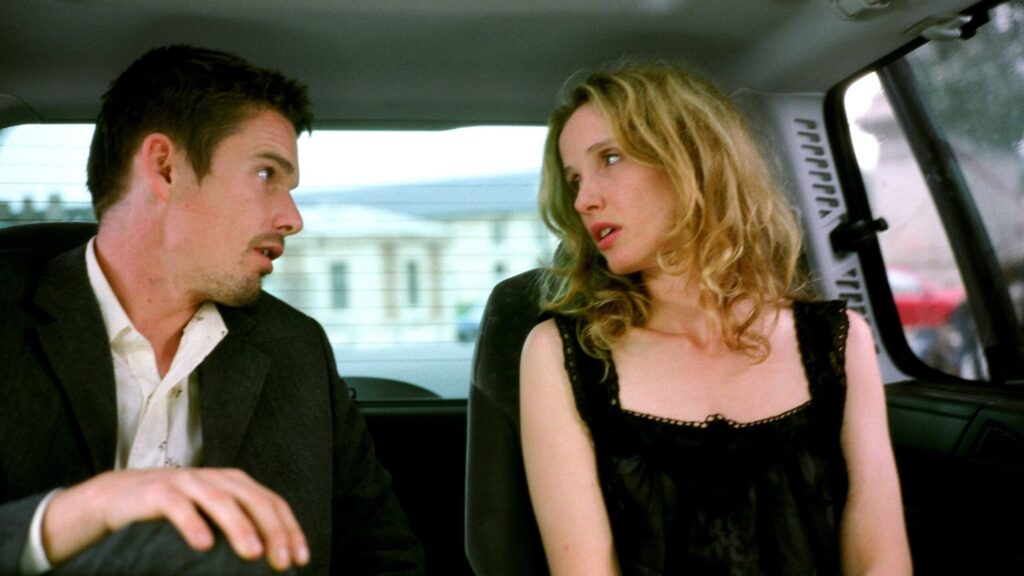
Outside of the themes, there are many impactful character moments throughout the film. When Jesse recalls moments of that fateful night in great detail, Celine remembers the glimmer of red in his goatee and how it glistened as the sun hit it. Another memorable moment takes place as they sail on a boat. Jesse has just opened up about his familial troubles to Celine and says, “If someone were to touch me, I think I would dissolve into molecules.” This line is referenced towards the end of the film when Celine unexpectedly hugs Jesse. Caught off guard, Jesse asks her, “What are you doing?” “Seeing if you burst into molecules,” she quips. There’s also the tense, yet important, cab ride. This is the scene when Celine admits the book stirred up feelings in her. It’s during this scene that Jesse reveals that one of the reasons for writing the book was that he hoped to find Celine and get a second chance. Already upset about the book, Celine finally tells Jesse that she’s pissed off because he comes to Paris all married and romantic. She doesn’t want to be a homewrecker, but with him being married, it seems unlikely the two will ever be together. Eventually, they calm down and arrive at Celine’s apartment.
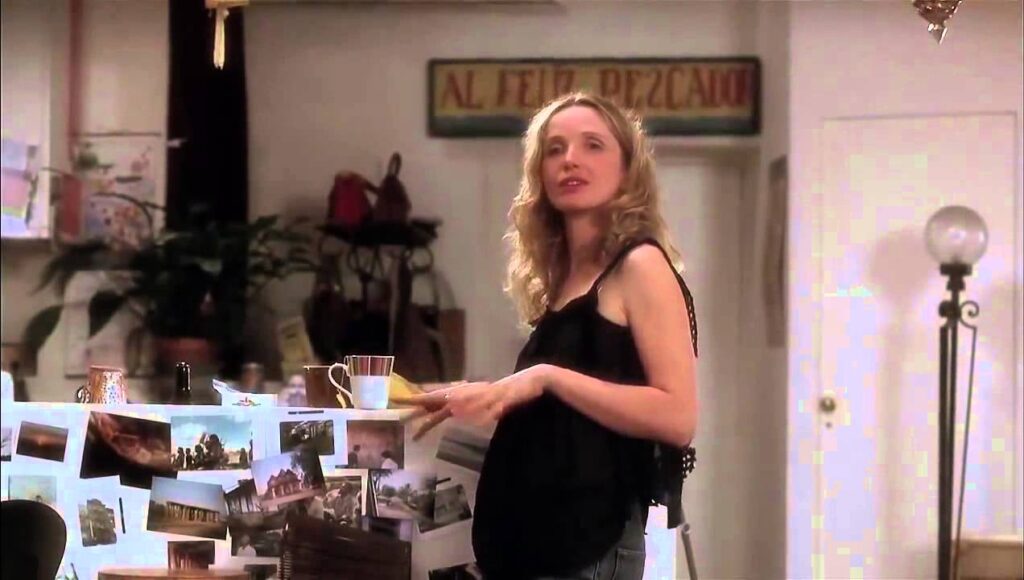
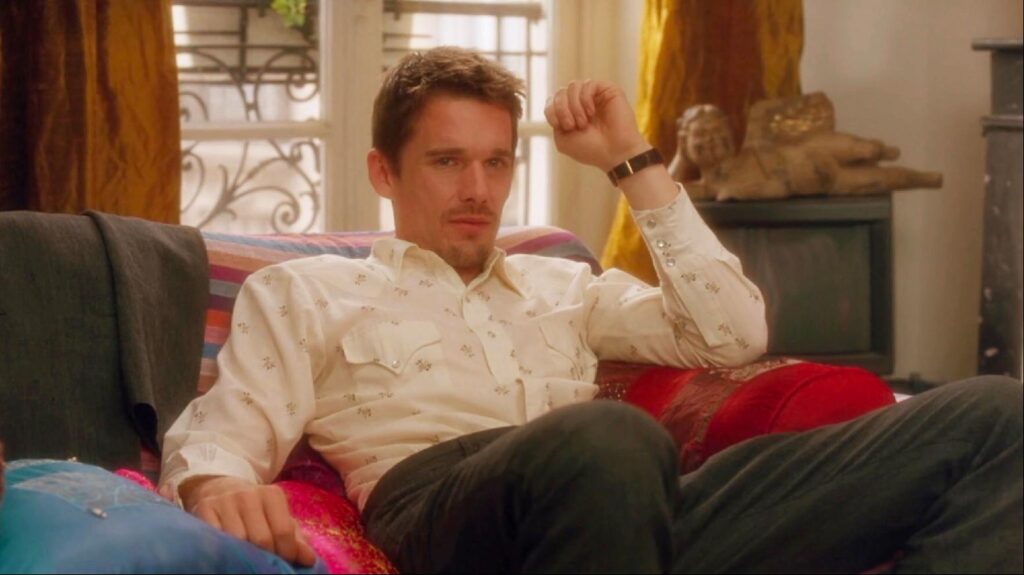
Despite her continued insistence that he should leave for the airport to not miss his flight, Jesse goes with her to the apartment. The apartment is filled with photos, souvenirs of good life, and a guitar. Although she is reluctant, Jesse convinces her to play a waltz that she wrote. The waltz is a recap of their night in Vienna. Jesse had the book; she had the song. He sits there mesmerized, listening to her guitar and beautiful vocals. When she’s done playing the song, she turns on her stereo to Nina Simone. As she dances around her apartment, she playfully reminds Jesse, “Baby, you are going to miss your flight.” “I know,” he replies with a big smile on his face. It cuts back to her dancing, then fades to black. It’s a beautiful, yet simplistic ending.
As I wrap up, I wanted to point out a couple of things. First is the cinematography. Linklater and cinematographer Lee Daniel give the film a consistent soft glow, reminiscent of sunset. That was appropriate. The next thing I noticed was how lean the film was. By most studio standards, 80 minutes is too short (and I might tend to agree), but it felt like the perfect length for what the film was trying to be. It’s also the only film in the trilogy to take place in real time. The other two installments have a condensed timeline. When the film was released in July 2004, it earned $16 million at the box office and garnered critical acclaim. At the 2005 Academy Awards, the film earned a nomination for Best Adapted Screenplay (under Academy rules, a sequel counts as an adaptation). Still, it lost to one of my favorite films, Sideways. Before Sunset is one of those few sequels that meet or exceed the expectations of the original. What are the odds Linklater and crew could do it again? I guess we will find out.